Define the fit
Name the kinds of businesses you know well, the stage at which you invest and the problems you understand.


The role of brand in private equity.
A perspective from Never Know Defeat.
Your difference has to be understood.

A founder choosing an investment partner is choosing people, judgement and a way of working. A private equity brand should make that choice easier. Can a founder recognise where your firm fits, see how you work and find evidence behind the promise?
Partnership, expertise and growth describe qualities a reader already expects. Give them something specific enough to choose your firm for.
Name the kinds of businesses you know well, the stage at which you invest and the problems you understand.
Show who picks up the phone after the deal and what a management team can actually ask them to do.
Be clear about the decisions the investor shares and the ones that stay with the business.
Choose a reader
Explain who they will work with, what support is available and how decisions are made. Help them picture the relationship.
Make the strategy, team and track record easy to connect. Keep the public story consistent with investor materials.
Make investment criteria and relevant contacts easy to find. Give them a clear basis for deciding whether an opportunity fits.
Could a founder explain why your firm is right for their business without repeating your tagline?
Back to chaptersMake the promise tangible.
Share of B2B respondents citing each quality
“Hands-on support” means little until a reader can picture it. Build a case around the problem, the people who took it on and what they can show.

Start with a challenge the business faced, such as entering a market, strengthening a team or improving how it operates.
Describe what management decided, where your team contributed and how the two worked together.
Use an approved account from management or a documented outcome. Give the timeframe and the context needed to interpret it.
The figures in this chapter opener come from a seven-country B2B survey. Respondents could select more than one quality. Edelman–LinkedIn, 2024
Back to chaptersGive the story a useful form.
The Tenzing identity in its workspace.
Start with the questions people bring to the firm. For Tenzing, that meant giving people access to its expertise. For Telemos Capital, it meant making its investment model easy to understand.

Tenzing brings insights, podcasts, events and portfolio stories into one digital home. A founder can experience how the firm shares knowledge before starting a conversation.

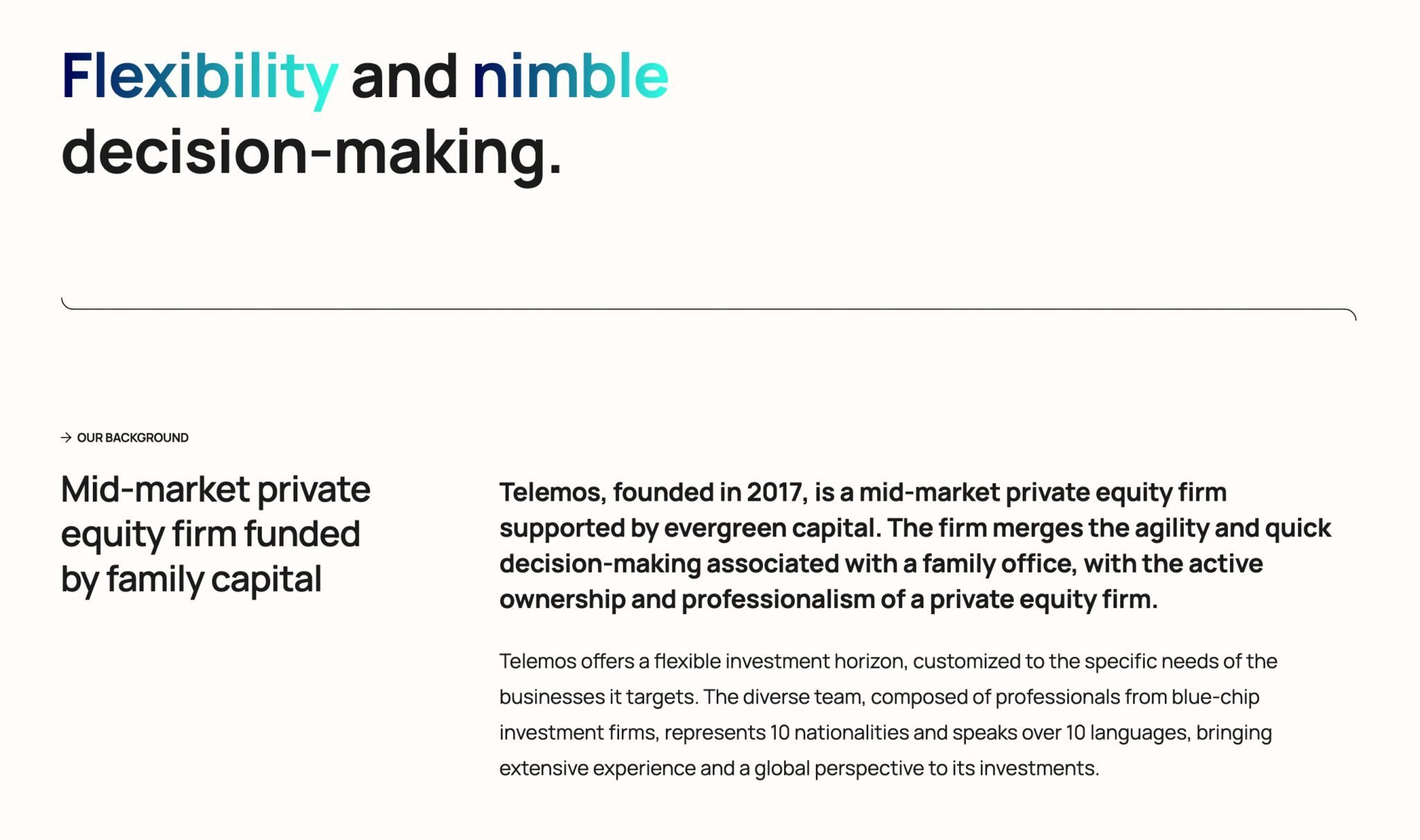
Telemos combines family capital with active ownership. Clear routes through its philosophy, portfolio and team help a visitor understand how that works in practice.
Decision-makers who say they are very likely to respond to consistently high-quality thought leadership in these ways.
B2B decision-makers; seven-country average. Source: report pp. 8–9. Edelman–LinkedIn, 2024
This is wider B2B research. For a private equity firm, the practical question is which expertise a visitor can use before getting in touch.
The investment firm’s reputation and the brands its companies own do different jobs. At each stage, start with the commercial plan and what customers already recognise.
Understand what customers value and recognise. Review the name, reputation, proposition and customer experience before deciding what to retain or change.
Decide how acquired businesses relate: separate brands, an endorsed family or one shared identity. Make that choice clear to employees and customers.
Check whether the proposition and website serve the customers you now want to reach. Support a new market or offer with relevant evidence and a clear route to enquiry.
Bring the business story, customer proposition and supporting evidence into alignment. Resolve contradictions between the website, sales materials and management’s account.
Look at your firm from the outside.
Put your homepage, an investor presentation and a portfolio story side by side. Use these six questions to decide what needs work first.
Can a founder find your sectors, business stage, geography and investment approach? Put the essentials together and use language a prospective partner can understand.
Read your proposition without the firm’s name. If a competitor could use it unchanged, add a specific capability, point of view or choice that is true to your business.
Underline the main promises on your homepage. Pair each with a relevant example, person or documented outcome. Prioritise the claims that currently have no support.
Look beyond biographies. Explain how the team works with management, who takes responsibility and what support looks like in practice. Invite an approved management perspective into the story.
Compare your website, presentation and recent communications. Resolve conflicting descriptions, outdated team details and inconsistent claims before adding new material.
Ask someone unfamiliar with your website to find a relevant case, the right person and a way to contact them. Check the journey on a phone and with a keyboard as well.
Leave the conversation with one priority, an owner and the evidence needed to act.
A dated website, an unclear proposition and an inconsistent identity call for different briefs. Choose the one that describes what your audience is struggling to understand.
If the story is unclear, agree who you want to reach, which strengths matter to them and what evidence backs those strengths up.
If the story is strong but hard to find, review the content, navigation and routes to relevant people. A focused website improvement may be enough.
If the strategy, audience or portfolio has changed, assess the name, positioning, identity and communications together. Protect what people already recognise.
Describe what has changed in the business, who needs to understand it, what they need to believe or do, and what evidence you already have. Agree how you will judge progress: clearer audience understanding, more relevant enquiries or a more consistent story across the team.
If your brand no longer reflects the firm or business you are building, let’s talk about what needs to change.
Arrange a conversation